
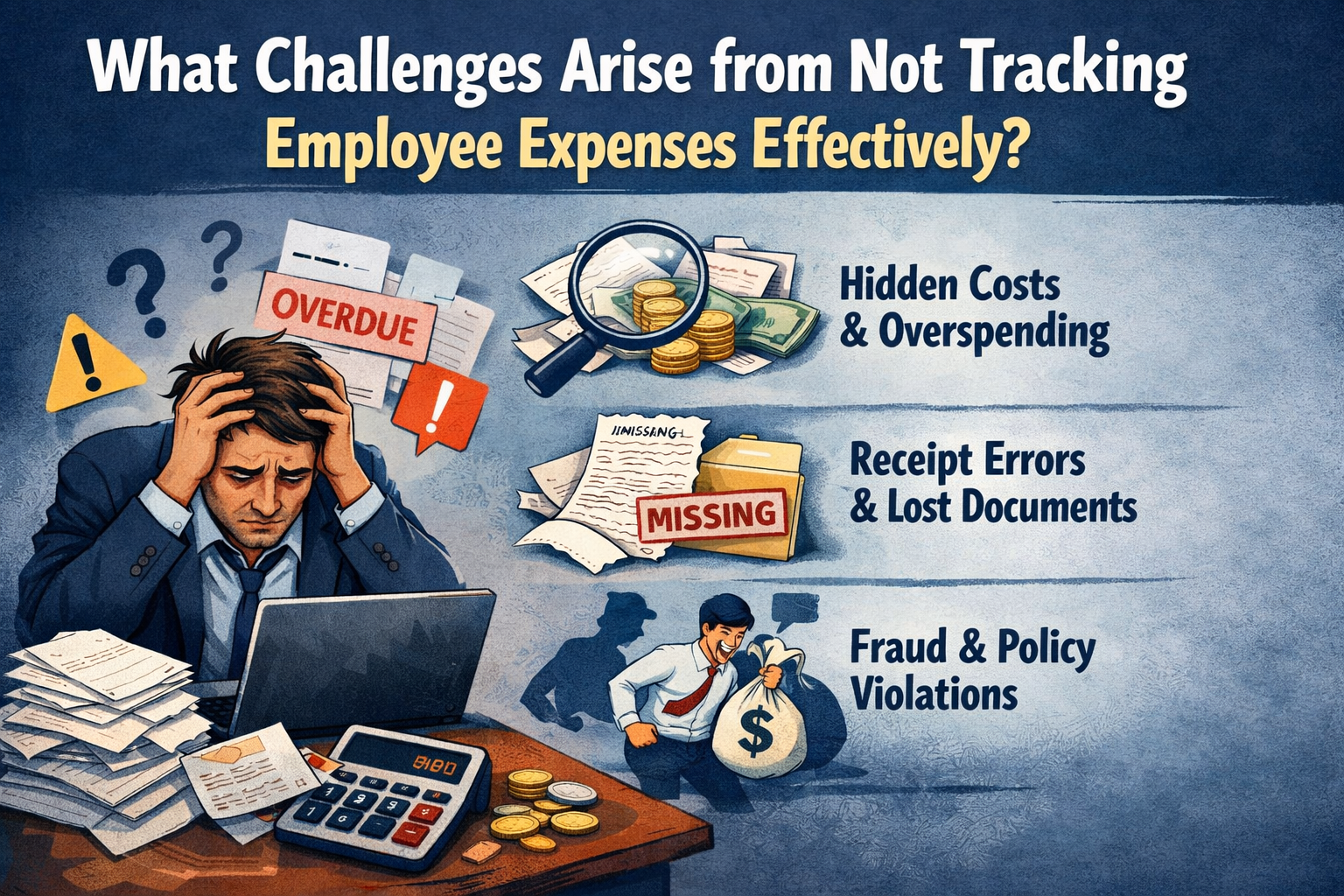
Not tracking employee expenses effectively can lead to a wide range of operational, financial, and strategic challenges.
Many organizations still rely on manual reporting, spreadsheets, or disconnected tools, which results in incomplete visibility, delayed approvals, and financial inaccuracies. Over time, these issues compound, impacting not just budgets and cash flow but also governance, employee trust, and leadership’s ability to make informed decisions.
Invisible & Frictionless Finance provides a framework for addressing these challenges by making expense tracking automatic, continuous, and embedded directly into everyday workflows rather than treated as an after-the-fact administrative task.
Without effective expense tracking, organizations struggle to enforce budgets or spending limits in real time. This creates an environment where overspending often goes unnoticed until after it has already occurred.
Common consequences include:
Manual reconciliation at month-end or quarter-end delays insight, meaning corrective action is always retrospective rather than preventative.
ExpenseOnDemand mitigates this risk by embedding continuous reconciliation and real-time budget checks across all spend types, ensuring financial discipline is maintained invisibly and consistently.
When expense tracking is inconsistent or manual, organizations become more vulnerable to fraud, duplicate claims, and policy breaches. These risks are often hidden within high volumes of low-value transactions.
Typical risk areas include:
Manual audits are resource-intensive and frequently detect issues only after payments have been made. In regulated industries, this can lead to fines, audit findings, or reputational damage.
Invisible & Frictionless Finance integrates preventative controls, AI-driven fraud detection, and automated policy enforcement at the point of submission, stopping non-compliant or suspicious claims before they enter the finance system.
Ineffective expense tracking places a heavy administrative burden on finance teams. Manual data entry, receipt chasing, and approval follow-ups consume time and slow down the reimbursement cycle.
This typically results in:
These inefficiencies divert finance resources away from analysis, forecasting, and strategic work.
By contrast, platforms like ExpenseOnDemand embed automatic capture, real-time validation, and continuous reconciliation, removing redundant steps and allowing finance teams to focus on higher-impact activities.
Poor expense tracking directly impacts the quality and timeliness of financial reporting. When expense data is incomplete or delayed, leadership teams are forced to make decisions using outdated or unreliable information.
Common reporting issues include:
This undermines budget planning and limits the CFO’s ability to respond quickly to emerging trends.
Invisible & Frictionless Finance ensures expenses are captured accurately and continuously, enabling real-time reporting and analytics that support proactive financial planning and control.
Expense management is one of the most frequent finance interactions employees have, and poor processes are immediately felt. Slow reimbursements, unclear policies, and manual reporting reduce trust and productivity.
Employee-facing challenges often include:
Over time, this friction can negatively affect morale and compliance.
With a seamless, automated, and policy-aware system, employees can submit expenses quickly and confidently, receive faster approvals, and stay aligned with company rules without added effort.
Without accurate and consistent expense data, organizations lack visibility into where money is actually being spent. This limits the ability to optimize costs or align spend with strategic goals.
Key limitations include:
Inconsistent data makes it harder to support procurement strategies, enforce sustainability initiatives, or benchmark performance across teams.
ExpenseOnDemand delivers consolidated, cross-functional analytics on spend and ESG metrics, giving CFOs a holistic view of organizational expenditure and enabling smarter, data-driven decisions.
Failing to track employee expenses effectively introduces financial, operational, and strategic risks, ranging from overspending and fraud to inefficiency and poor decision-making. These challenges grow over time and are difficult to resolve once embedded in daily operations.
Invisible & Frictionless Finance addresses these risks by embedding automation, continuous reconciliation, preventative controls, and real-time visibility directly into workflows. ExpenseOnDemand enables organizations to capture, monitor, and govern spend across all channels invisibly, providing finance teams and employees with a seamless, reliable, and compliant expense management experience.
By tracking every expense effectively, organizations reduce risk, improve efficiency, and gain the insight needed to make better decisions and support sustainable growth.
To learn more about how our spend and expense management software can support your goals, book a demo with us today.
Connect With Us



%201.png)



-transformed.png)