
Monitoring employee expense reports in real time is essential for maintaining financial control, preventing overspending, and ensuring consistent policy compliance. Traditional expense management systems typically rely on monthly or quarterly reporting cycles, creating significant blind spots for finance teams. By the time issues are identified, errors have already occurred and correcting them requires time-consuming manual intervention.
Invisible & Frictionless Finance addresses this challenge by embedding real-time monitoring directly into everyday workflows, giving finance leaders continuous visibility into spend activity without interrupting employees or slowing operations.
Real-time monitoring starts with capturing expenses at the exact moment they occur. Every spend event, whether a card transaction, reimbursement, travel booking, invoice, or mileage entry, must enter the system immediately.
Modern capture methods include:
ExpenseOnDemand uses these tools to ensure spend is recorded cleanly and accurately, without manual data entry. This gives finance teams instant visibility into expenses rather than waiting for post-submission approvals or end-of-period reports.
Real-time monitoring is only effective when expenses are reconciled continuously. Without reconciliation, visibility remains incomplete and unreliable.
Continuous reconciliation ensures:
By reconciling spend as it occurs, finance teams can see the live state of organizational spend and address issues immediately, rather than uncovering them during month-end close.
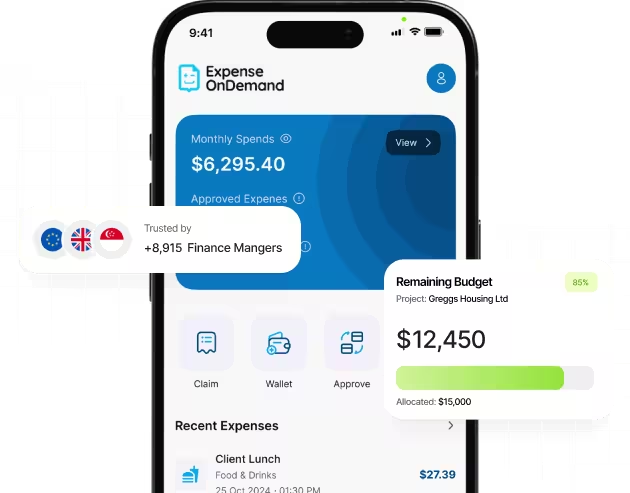
A single, centralised view of spend is critical for real-time oversight. Finance leaders need one source of truth that consolidates expense data across the organisation.
Effective dashboards provide:
AI-powered analytics enhance this visibility by predicting overspending, highlighting unusual behaviour, and generating alerts for potential policy breaches, all running invisibly in the background.
Monitoring alone does not prevent financial risk. Best practice embeds preventive controls directly into the expense workflow so issues are addressed before they escalate.
Preventive controls include:
This approach ensures monitoring is not just observational but actionable, stopping problems at the point of occurrence rather than reacting after the fact.
Real-time monitoring should not be limited to desktop dashboards. Managers and finance teams benefit from mobile access that allows them to stay informed wherever they are.
Mobile monitoring enables:
This reinforces accountability and responsiveness without introducing meetings, emails, or manual reporting overhead.
Accurate real-time monitoring depends on seamless integration with core systems. Expense data must align with organizational structure and financial records automatically.
Key integrations include:
Native integration ensures real-time data can be trusted without manual checks, allowing finance teams to monitor spend confidently and effortlessly.
A frictionless system balances strong oversight with employee convenience. Real-time monitoring should never feel intrusive or restrictive.
Instead, it enables employees to:
Oversight remains continuous and robust, while employees experience a simple, seamless process that supports productivity.
Real-time monitoring of employee expense reports transforms finance from reactive to proactive. By combining instant expense capture, continuous reconciliation, centralised dashboards, preventive controls, mobile access, and deep system integration, organisations gain complete visibility into spend as it happens.
Invisible & Frictionless Finance ensures this monitoring operates quietly in the background. With ExpenseOnDemand, finance leaders can detect anomalies, enforce policies, and optimize budgets in real time, while employees continue their work uninterrupted. Monitoring becomes an always-on capability rather than a periodic administrative burden.
To learn more about how our spend and expense management software can support your goals, book a demo with us today.
%201.png)