By clicking “Accept All Cookies”, you agree to the storing of cookies on your device to enhance site navigation, analyze site usage, and assist in our marketing efforts. View our Privacy Policy for more information.
This is some text inside of a div block.

Your Complete & Unabridged Guide to Spend Management

Our experts in spend management software talk through the process in detail.
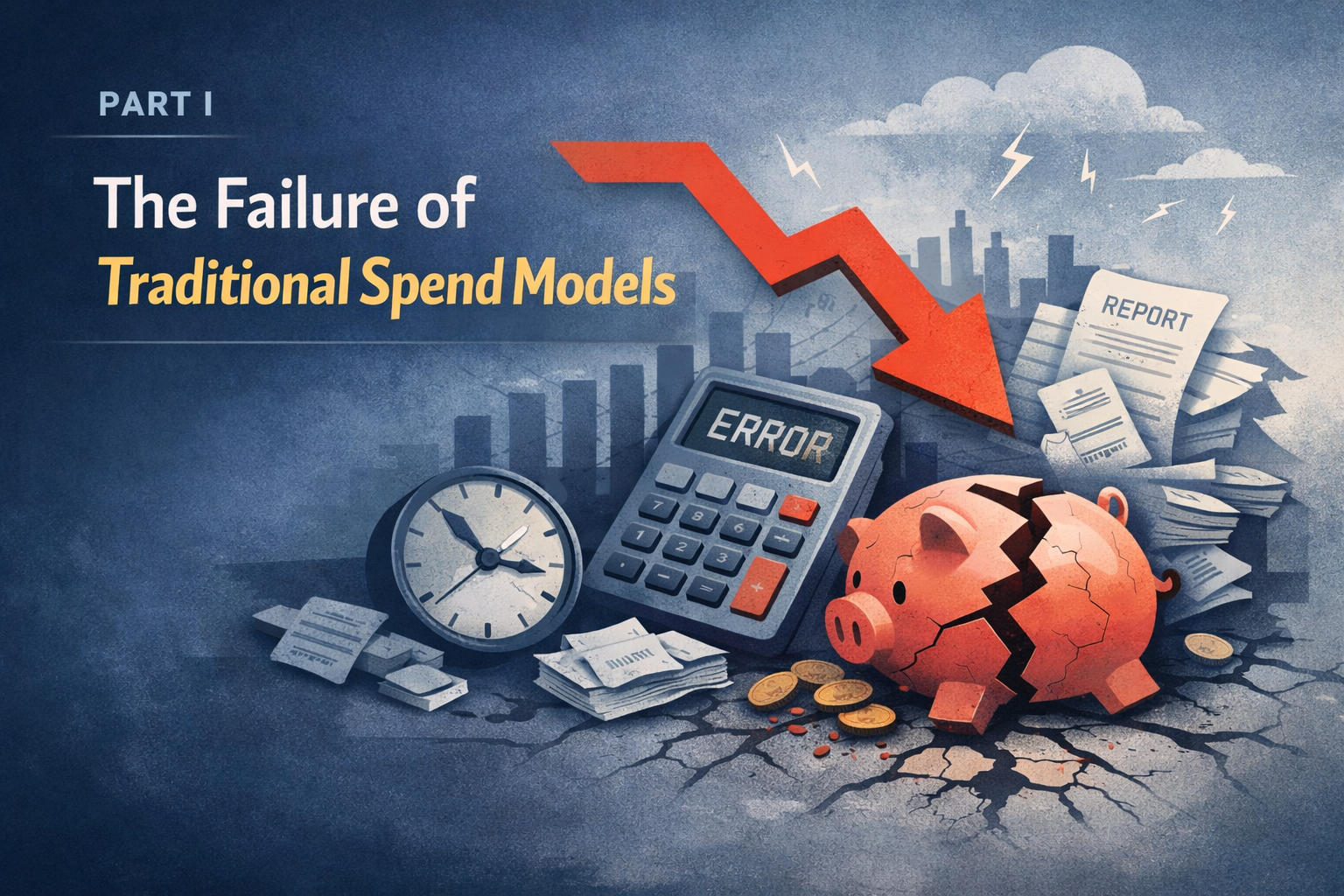
Part I — The Failure of Traditional Spend Models

1. Spend Is No Longer an Accounting Problem — It’s a Strategic Risk Surface

For decades, organisations treated spend as little more than an accounting artefact. Money left the business, receipts returned, reports were generated, and finance ensured that—on paper—things balanced. This paradigm worked when businesses moved slowly, hierarchies were rigid, and financial authority was concentrated in the hands of a small group of senior operators.

That world no longer exists.

Today, spend is continuous, pervasive, and decentralised. Decisions are made by hundreds or thousands of employees across multiple channels: corporate cards, subscriptions, reimbursements, marketplaces, procurement platforms, and software-as-a-service tools. Spend occurs in real time, often invisible to finance until it is too late.

Yet most finance systems are still built to observe spend retrospectively, after the transaction has cleared. This misalignment has transformed spend from a procedural issue into one of the largest unmanaged risk surfaces in modern organisations.

Spend today touches every strategic and operational axis of the business:

  • Cash flow predictability: Decentralised spend introduces uncertainty in liquidity and forecasting.
  • Regulatory compliance: Unmonitored expenditures create exposure to tax, reporting, and jurisdictional violations.
  • Fraud exposure: Unauthorised transactions and shadow spend multiply the attack surface.
  • ESG accountability: Untracked purchases undermine sustainability and ethical sourcing commitments.
  • Employee experience: Complex, reactive processes frustrate staff and reduce operational efficiency.
  • Vendor concentration risk: Fragmented spend increases dependency on certain suppliers, impacting negotiation leverage.
  • Margin leakage: Invisible or mismanaged spend erodes profit margins and reduces strategic capital.

Despite these risks, organisations continue to rely on outdated tools and processes never designed for real-time, scalable, distributed control. Finance functions are trapped in a reactive loop—closing gaps, chasing receipts, resolving exceptions—rather than actively shaping behaviour upstream.

Spend is no longer about recording what happened. It is about controlling what is allowed to happen.

2. The Structural Flaws of Reactive Finance

Traditional spend management is reactive by design. In most organisations:

  • Expenses are incurred first, justified later.
  • Approvals often occur after the transaction.
  • Controls are enforced retrospectively.
  • Insights arrive weeks after the decision that triggered risk.

This structure creates three critical strategic failures:

  1. Control Happens Too Late
    By the time finance becomes aware of a transaction, the money has already left the business. At best, finance can recover documentation or reclassify costs. At worst, the organisation absorbs the financial loss. This is damage control, not governance. Strategic objectives like cost optimisation, risk management, or cash preservation are left unmet.

  1. Compliance Becomes Adversarial
    When controls operate retroactively, finance is forced into a policing role. Employees perceive the expense process as bureaucratic, punitive, and slow. This creates predictable behavioural adaptations: receipts are delayed, justifications retrofitted, and policies circumvented. What was intended as oversight becomes friction, undermining both trust and compliance.

  1. Insight Is Disconnected From Action
    Traditional reporting focuses on hindsight: month-end reports, variance analyses, dashboards. While these explain what happened, they do nothing to prevent the next misalignment. Finance becomes an observer of outcomes, unable to proactively influence spending behaviour or strategic alignment.

The operational consequences of reactive finance are enormous:

  • Manual reconciliations consuming excessive headcount
  • Continuous exception handling and ad-hoc problem solving
  • Interpretative debates over policy application
  • Email-based approvals and notification chains
  • Spreadsheet-based workarounds to reconcile data silos

Yet, despite this heavy operational burden, finance leaders still lack confidence in real-time numbers until weeks after the close.

The problem is not execution; it is architecture. Reactive models treat spend as a series of discrete events rather than a continuous, governed system.

3. Why Expense Tools, Card Programs, and ERPs Fail in Isolation

Most organisations attempt to improve spend management incrementally, deploying:

  • An expense management tool to handle reimbursements
  • A corporate card program to reduce out-of-pocket spend
  • An ERP to record transactions
  • A procurement system for large or planned purchases

Each system functions within its own silo, creating gaps at the intersections.

Why these systems fail strategically:

  • Expense tools assume spend has already occurred; they cannot prevent or shape decisions.
  • Card programs optimise payment flow, not governance or compliance.
  • ERPs record the financial truth but have no concept of intent or risk at the point of spend.
  • Procurement systems focus on planned, large purchases, ignoring the “long tail” of operational spend.

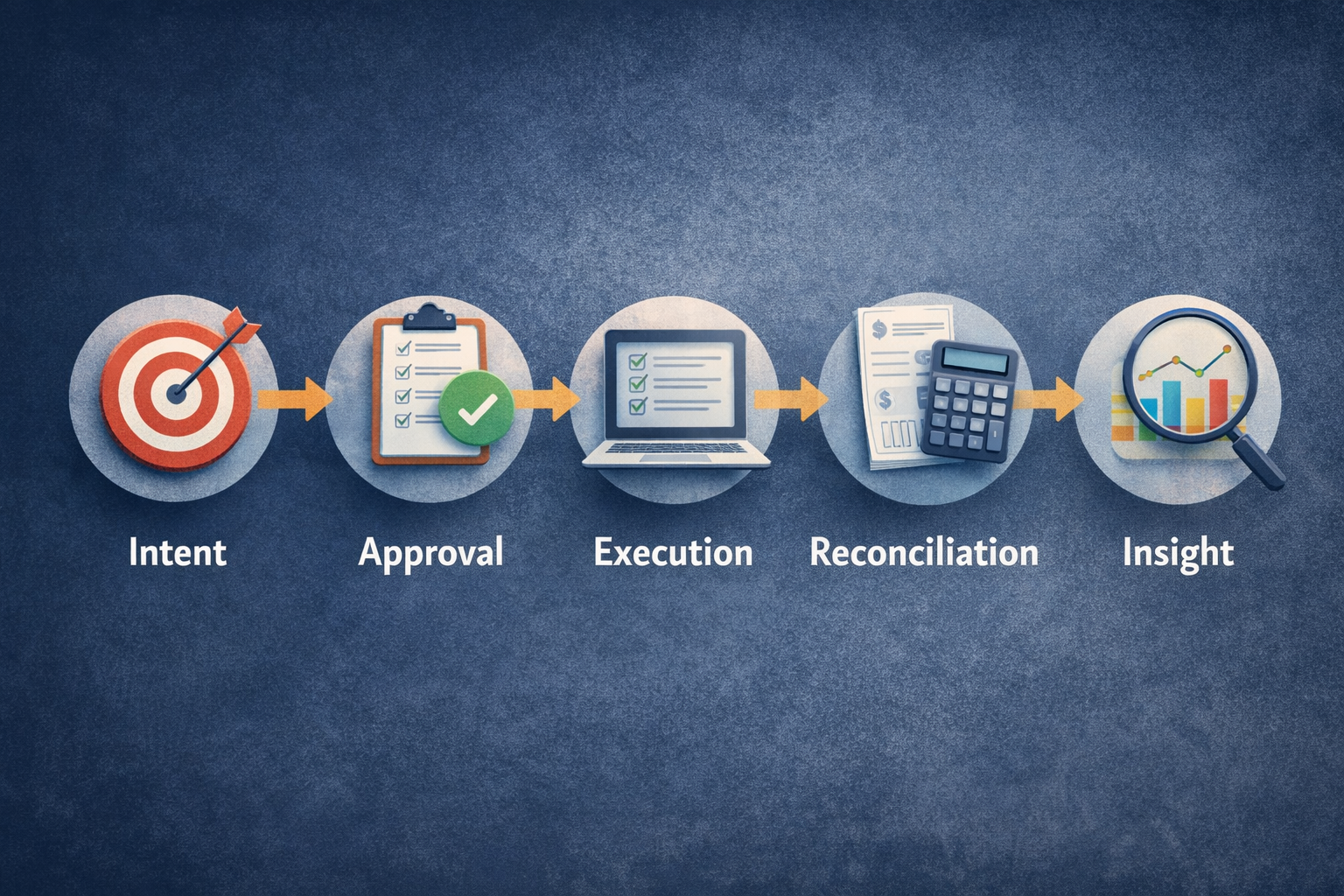
No system owns the full lifecycle of spend:

Intent → Approval → Execution → Reconciliation → Insight
As a result, finance teams are forced to stitch together partial truths across multiple touchpoints:

  • Policies live in static documents
  • Approvals live in inboxes
  • Transactions live in banks
  • Receipts live on employee devices
  • Reconciliation lives in spreadsheets

This fragmentation explains why even well-resourced finance teams struggle with:

  • Duplicate or inconsistent spend
  • Policy drift and uncontrolled exceptions
  • Shadow procurement and subscription sprawl
  • Inconsistent coding and delayed financial closes

The tools are not broken. The model is.

4. The Hidden Cost of Reconciliation and “Month-End Finance”

Reconciliation has quietly become one of the most expensive and least questioned activities in finance.

Monthly activities include:

  • Matching transactions to receipts
  • Validating coding
  • Resolving exceptions
  • Adjusting accruals
  • Chasing missing data

This work scales linearly with complexity, meaning that as transaction volume increases, reconciliation effort rises disproportionately. Organisations respond by adding headcount—not strategic insight.

The hidden consequences of traditional reconciliation:

  • Massive operational cost with minimal strategic value
  • False sense of security: balanced books do not equate to controlled spend
  • Delayed decision-making and misalignment with organisational objectives
  • Month-end close becomes a crisis management exercise, rather than a governance checkpoint

Month-end finance is symptomatic of a deeper problem: systems are batch-oriented in a world that demands real-time visibility and control.

Until organisations move beyond the acceptance of reconciliation as inevitable, they cannot achieve true spend governance, nor can they turn spend into a strategic lever for growth, risk management, or competitive advantage.
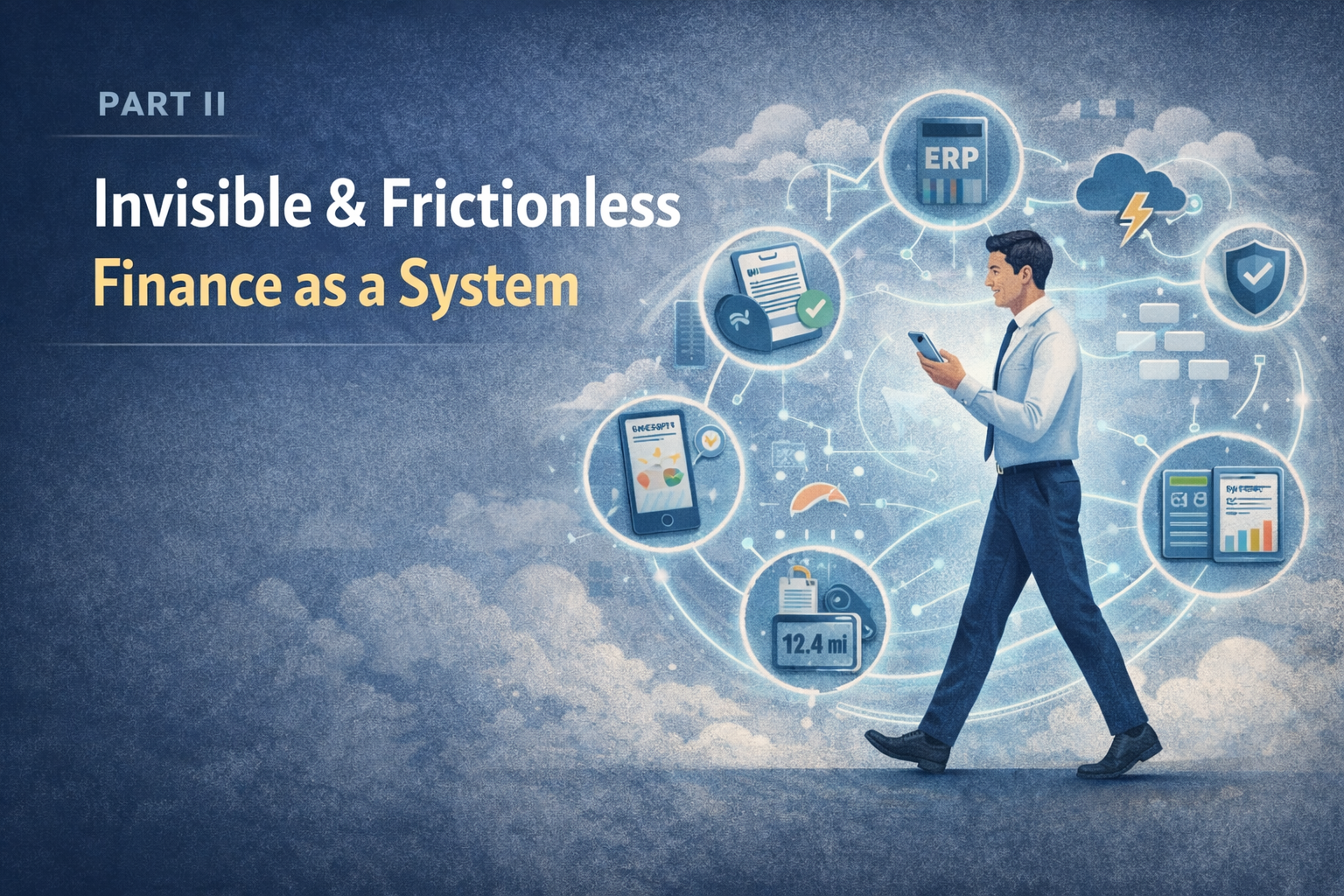
Part II — Invisible & Frictionless Finance as a System

5. Invisible Finance Is Not About UX — It’s About Behaviour

Invisible finance is often mischaracterised as a user interface goal: fewer clicks, cleaner forms, or faster claim submissions. While these are desirable, they are superficial outcomes, not strategic levers.

At its core, invisible finance is behavioural architecture. It is about designing systems that embed governance into the natural flow of work, making compliant behaviour the default rather than the exception.

In an invisible finance system:

  • Employees act without conscious concern for policies; rules are enforced automatically.
  • Low-risk approvals are handled in real time without human intervention.
  • Exceptions and anomalies surface immediately, not weeks later at month-end.
  • Finance shifts from firefighting to strategic oversight by design, intervening where risk demands attention.

The strategic objective is not to remove control. Rather, it is to:

  • Remove friction where risk is low
  • Apply precision where risk is material
  • Enable scalable governance across a distributed workforce

This transforms finance from a reactive department into a forward-looking control system, where governance and productivity coexist.

6. Frictionless Does Not Mean Control-Free

Frictionless finance is often misunderstood by CFOs. “Less friction” can sound like reduced oversight — and many fear this will erode control.

In reality, frictionless systems enable stronger, smarter control, because they operate earlier in the lifecycle, with contextual intelligence.

Traditional finance controls rely on blunt instruments:

  • Static spend limits
  • Manual approval chains
  • Rigid expense categories

These are binary, reactive, and inefficient, creating unnecessary bottlenecks and employee frustration.

Modern systems apply contextual, real-time control:

  • Who is spending (role, seniority, department)
  • What is being purchased (expense type, category, risk profile)
  • With which vendor (approved, high-risk, new supplier)
  • Against which budget (project, cost center, department allocation)
  • At what time (timing, cash flow impact, policy constraints)
  • Under what policy (automated compliance with dynamic thresholds)

By evaluating intent rather than outcomes, organisations can allow low-risk spend to flow freely, while focusing human and technological oversight on high-risk or unusual transactions.

This is how organisations build high-trust, scalable finance systems, where control and efficiency reinforce, rather than conflict with, each other.

7. Spend Intent: The Missing Control Layer

The most powerful, yet often ignored, question in spend management is:

“Should this spend happen at all?”

Traditional finance systems focus on retrospective compliance:

  • Was it coded correctly?
  • Was a receipt submitted?
  • Did it fall within policy?

These questions are reactive and occur after risk has been realised.

Intent-based systems shift the control point upstream. Capturing spend intent before funds leave the organisation allows finance to:

  • Dynamically enforce budgets based on real-time availability and priorities
  • Prevent unauthorised vendors or off-policy purchases
  • Flag anomalies instantly, using historical patterns, AI models, or rules-based triggers
  • Automate approvals where risk is low or predictable

Technologies like AI, voice capture, and rule-based orchestration are not superficial tools; they are strategic control mechanisms that enable finance to operate proactively.

8. Preventive Governance vs Retrospective Compliance

Preventive governance fundamentally changes the role of finance.

Instead of being:

  • Auditors
  • Policers
  • Problem-solvers

Finance becomes a system designer and behaviour shaper. Policies are encoded into workflows, approvals are data-driven, and exceptions are handled in real time. Compliance is achieved by design, not by enforcement after the fact.

The strategic benefits are substantial:

  • Reduced fraud exposure: high-risk transactions are intercepted upstream.
  • Lower cognitive load: employees operate without procedural uncertainty.
  • Administrative efficiency: repetitive manual work is eliminated.
  • Increased trust: transparent, predictable processes strengthen confidence across the organisation.
  • Faster decision-making: actionable insights are available continuously, not retroactively.
  • Higher data quality: clean, accurate financial data is captured at the point of decision, not retrofitted.

Finance evolves from reactive record-keeping to proactive governance, directly influencing organisational performance.

9. Continuous Reconciliation as a Permanent State

Reconciliation is traditionally a discrete, resource-intensive event, occurring at month-end. In frictionless finance, reconciliation becomes a continuous, automated process.

Key characteristics of continuous reconciliation:

  • Transactions are matched automatically as they occur
  • Coding is applied at source, eliminating manual categorisation
  • Exceptions surface instantly, enabling immediate intervention
  • Month-end becomes validation rather than correction, freeing finance teams to focus on insight and strategy

This is only achievable when the finance system is fully unified, intent-aware, and integrated across spend channels. Continuous reconciliation transforms finance from a reporting function into a live, strategic operating system.

10. Why Unifying AP, Procurement, Expenses, and Cards Matters

Most organisations treat accounts payable (AP), procurement, expense reimbursements, and corporate cards as separate systems. Employees experience them as disconnected, and finance struggles to achieve consistent governance.

From a strategic perspective, this separation is artificial. Spend is spend, regardless of channel or mechanism.

When all spend flows through a single, unified control plane:

  • Policies are consistent across all channels
  • Data is coherent, allowing accurate, real-time reporting
  • Visibility is immediate, reducing risk and improving strategic planning
  • Decisions are defensible, with auditable, upstream controls

This unified approach is the foundation of invisible and frictionless finance — not a UX goal, not a process improvement, but a strategic operating system that transforms spend from a liability into a lever for control, efficiency, and enterprise-wide trust.

Strategic takeaway for executives:


Invisible and frictionless finance is not a design trend — it is a system-level transformation. It shifts finance from a reactive, bureaucratic function to a proactive, high-leverage discipline capable of:

  • Reducing risk
  • Increasing speed and trust
  • Optimising cash flow
  • Enabling strategic allocation of resources

It is the only model capable of controlling spend at scale in a modern, decentralised organisation.

Part III — The Modern Spend Lifecycle: From Intent to Insight

For decades, organisations described spend management as a linear, administrative process: an employee spends money, submits a claim, finance approves it, and accounting records it.

This view is not only outdated — it is strategically flawed.

Spend is not a transaction; it is a lifecycle. The most critical decisions occur before the money leaves the organisation, yet most businesses only start paying attention halfway through the lifecycle, long after risk has been realised and strategic leverage is lost.

The modern enterprise cannot afford this. Fragmented spend leads to:

  • Strategic misalignment of budgets
  • Escalating risk exposure
  • Reduced negotiating leverage with vendors
  • Inefficient capital allocation
  • Cumulative margin leakage

To govern spend effectively, organisations must treat it as a lifecycle — a continuous process from intention to strategic insight.

11. The Five Stages of the Modern Spend Lifecycle

Every instance of business spend — whether a coffee receipt, a supplier invoice, a subscription renewal, or a multi-million-dollar procurement contract — follows the same five-stage lifecycle:

  1. Intent – The moment a need to spend arises. The decision point that seeds downstream risk.
  1. Approval – Validation against policy, budget, and authority. A decision to permit or deny the spend.
  1. Execution – The spend occurs: funds are disbursed or obligations incurred.
  1. Reconciliation – The transaction is matched, coded, and recorded. Errors and exceptions are identified.
  1. Insight – The spend informs decisions, forecasts, and strategy.

Most traditional finance systems only operate effectively in stages 4 and 5, after risk has materialised. ExpenseOnDemand, in contrast, is designed to operate across all five stages, embedding control, intelligence, and influence at the point of decision.

Stage One: Intent — Where Control Is Either Won or Lost

Intent is the moment of maximum leverage.

This is the point where budgets are allocated, policies applied, and risk is seeded. If intent is invisible or unmanaged:

  • Budgets are theoretical, often overstretched or misaligned with strategic priorities
  • Policies are subjective, leading to inconsistent enforcement
  • Approvals become reactive, creating bottlenecks and inefficiency
  • Finance only discovers risk after exposure, often too late to mitigate

Capturing intent upstream allows organisations to:

  • Dynamically enforce budgets in real time, prioritising spend where it delivers maximum strategic impact
  • Prevent unauthorised vendors, reducing operational and reputational risk
  • Flag anomalies instantly using predictive models and AI
  • Automate low-risk approvals, freeing human decision-making for high-risk or strategic spend

Strategic shift: The question moves from “Was this expense valid?” to “Is this spend appropriate given the business context, risk profile, and strategic objectives?”

This transforms finance from a reactive observer into a strategic decision-shaper.

Stage Two: Approval — From Human Bottlenecks to Policy Engines

Manual approvals are a blunt instrument, creating:

  • Approval inflation: unnecessary human intervention slows workflow
  • Control illusions: approvals don’t prevent policy violations upstream
  • Shadow behaviour: employees circumvent slow processes, creating hidden risk

Modern approvals are conditional, contextual, and automated:

  • Conditional rules apply based on risk scoring, spend type, and user profile
  • Contextual intelligence ensures only material or high-risk transactions require human review
  • Automated approvals accelerate low-risk spend while enforcing compliance

Strategic impact: Finance can focus human oversight where it adds value, rather than policing routine transactions, turning approvals into a lever for both control and speed.

Stage Three: Execution — Where Most Systems Start (Too Late)

Execution is when money actually leaves the business. Traditional systems act here, reactively, detecting and controlling spend after risk is realised.

Modern systems integrate execution with upstream intent:

  • Funds are released only for pre-approved, policy-compliant transactions
  • Dynamic controls adjust limits based on cash flow, risk scoring, or project priority
  • AI and analytics detect anomalies or duplicate spend before settlement, not after

Strategic impact: Execution becomes a governed outcome, rather than a reactive checkpoint, reducing risk and aligning spend with organisational objectives.

Stage Four: Reconciliation — The Most Over-Engineered Failure Point

Reconciliation has become expensive because it compensates for fragmented systems: multiple tools, channels, and spreadsheets.

Continuous reconciliation flips this model:

  • Transactions are matched as they occur, not at month-end
  • Coding and categorisation are applied at source
  • Exceptions surface in real time, enabling instant resolution

Month-end becomes confirmation, not correction, freeing finance teams to focus on strategic insight and forecasting.

Strategic impact: Reduces operational cost, eliminates error propagation, and ensures finance maintains visibility and control in real time.

Stage Five: Insight — Too Late in Traditional Systems

Traditional insight answers the question: “What happened?”

Modern insight is predictive and prescriptive:

  • Answers “What is likely to happen?”
  • Guides decisions on budgets, projects, vendor strategy, and capital allocation
  • Detects anomalies, patterns, and emerging risks proactively

Strategic impact: Finance transforms from a reporting function to a strategic adviser, turning spend data into actionable intelligence and enterprise-wide foresight.
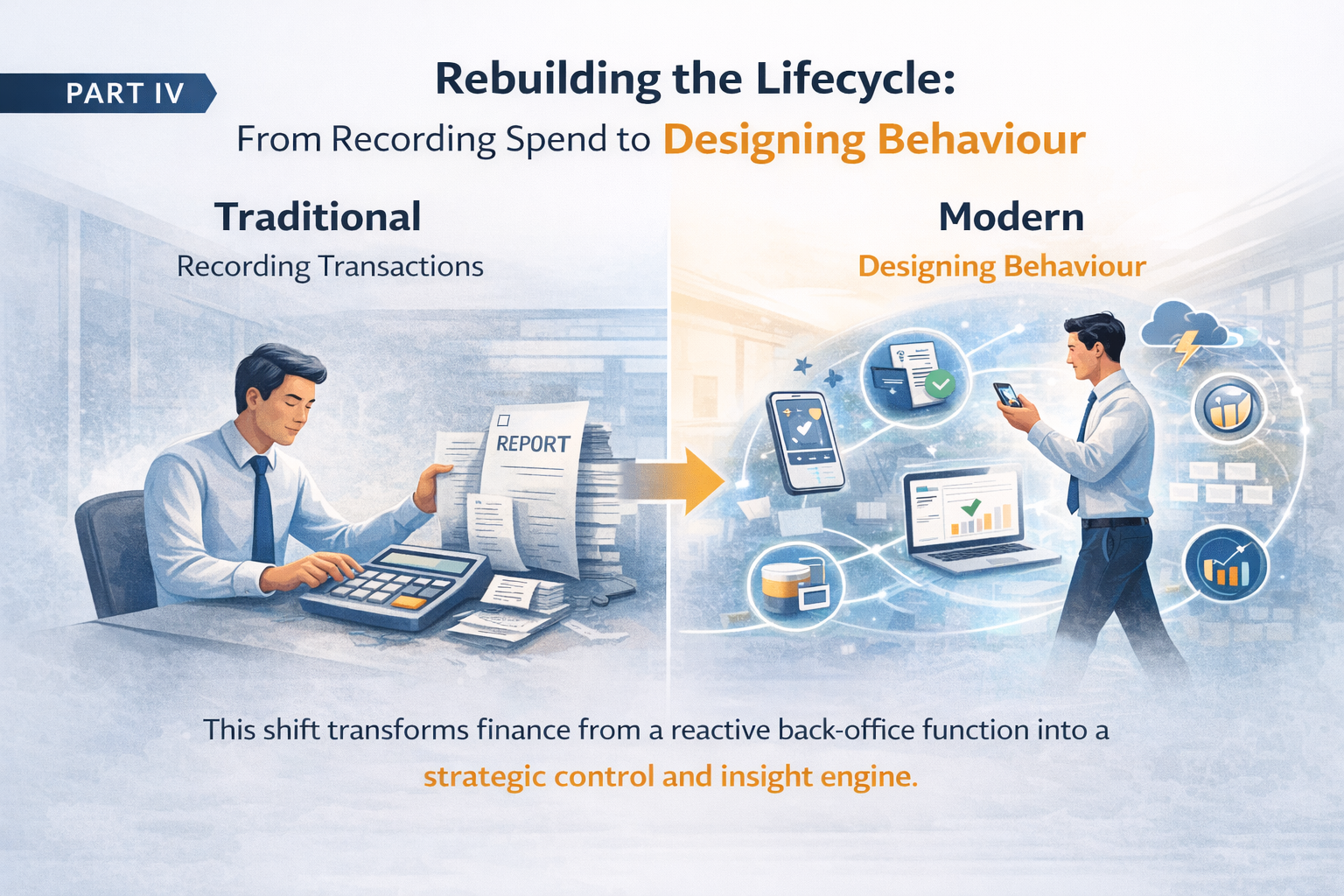
Part IV — Rebuilding the Lifecycle: From Recording Spend to Designing Behaviour

Traditional finance focuses on recording transactions. Modern finance must focus on designing behaviour, creating systems that influence how, when, and why employees spend. This shift transforms finance from a reactive back-office function into a strategic control and insight engine.

12. Finance as a Behavioural System – Shape Decisions, Don’t Just React

In the traditional model, finance waits for events to occur, then enforces compliance retrospectively. This creates a reactive, low-trust environment.

Modern finance should operate as a behavioural system:

  • Embed rules into workflows so compliance is automatic.
  • Reduce cognitive load on employees — they don’t have to “think” about policy; it’s enforced by design.
  • Focus human intervention where risk is highest, rather than reviewing every low-risk transaction.

Strategic benefits:

  • Proactive risk management: Policies prevent errors, fraud, and policy violations before they occur.
  • Operational efficiency: Teams spend less time reconciling and more time driving strategic initiatives.
  • Employee trust and adoption: Clear, automated processes reduce frustration and increase compliance.

Example: If a team member requests to purchase software, the system can automatically check licensing availability, vendor compliance, and budget allocation before approval, preventing over-spend and policy breaches upstream.

13. Encoding Policy as Software – Living Rules, Not Static PDFs

Policies in most organisations exist as documents or manuals, which are interpreted inconsistently. Encoding policy as software turns rules into dynamic, enforceable controls:

  • Policies are embedded into workflows, approvals, and spend systems.
  • Budgets, vendor restrictions, and compliance requirements are enforced at the point of decision.
  • Rules adapt dynamically to context, such as employee role, department, project, or risk score.

Strategic benefits:

  • Consistency: Policies are applied uniformly across departments, locations, and spend types.
  • Scalability: Rules are enforced automatically for millions of micro-decisions without additional headcount.
  • Auditability: Every decision is traceable, creating a strong governance and compliance footprint.

Example: A procurement policy restricting new vendor onboarding outside a certain risk threshold can be enforced automatically; exceptions trigger alerts, ensuring finance oversight without slowing legitimate purchases.

14. Trust as an Output – Strong Control Produces Trust Naturally

In traditional finance, trust is often assumed or demanded. Modern systems build trust through design:

  • Predictable rules and automated enforcement reduce uncertainty.
  • Real-time visibility ensures stakeholders always know the status of spend and compliance.
  • Exceptions and escalations are transparent, demonstrating control without friction.

Strategic outcome: Trust becomes a byproduct of intelligent systems, rather than a manually enforced cultural expectation. Employees feel empowered, while executives gain confidence in data integrity and risk management.

15. Continuous Finance – Month-End Closes Are Validation, Not Rescue

Traditional finance relies on batch-based, month-end processes to reconcile, validate, and report transactions. This approach:

  • Consumes enormous manual effort
  • Delays insight
  • Creates risk blind spots

Continuous finance reimagines the process as ongoing, real-time governance:

  • Reconciliation happens as transactions occur.
  • Exceptions are resolved immediately, reducing downstream errors.
  • Month-end closes become validation checkpoints, not crisis points.

Strategic impact:

  • Finance teams can redirect effort from manual reconciliation to analysis, planning, and strategy.
  • Real-time visibility supports cash flow forecasting, strategic spend allocation, and proactive risk mitigation.
  • Decision-makers have actionable insights at the moment of spend, not weeks later.

Rebuilding the spend lifecycle transforms finance from a reactive, transactional function into a strategic system of governance, behavioural design, and insight generation. Organisations gain agility, risk control, and operational efficiency.

Part V — Why This Shift Is Inevitable

The transformation from reactive finance to a behaviour-driven, continuous system is not optional. Three forces make it unavoidable for modern organisations:

16. Scale – Humans Cannot Govern Millions of Micro-Decisions

Modern businesses operate with distributed teams, hundreds of projects, and thousands of individual spend decisions. Manual approvals and reconciliations are no longer feasible:

  • Each employee makes dozens of micro-decisions daily.
  • Traditional systems rely on headcount to enforce policy, creating exponentially rising operational costs.

Strategic imperative: Systems must govern at scale, using automation and intelligent controls, rather than relying on human effort alone.

17. Speed – Businesses Operate Faster Than Monthly Cycles

Decisions now happen in real time:

  • Cloud subscriptions auto-renew
  • SaaS usage spikes overnight
  • Procurement requests arise on-demand

Monthly or quarterly finance cycles are too slow to manage risk or optimise spend. Organisations must shift governance and insight into real-time, so finance can act when decisions are made, not after the fact.

Strategic imperative: Finance must operate as a real-time control system, influencing spend at the moment of intent, not post hoc.

18. Complexity – Spend Is Decentralised and Unpredictable

Spend today is fragmented across:

  • Cards, subscriptions, and vendor marketplaces
  • Project budgets and cost centers
  • Multi-jurisdiction regulatory requirements
  • ESG and sustainability commitments

Traditional finance is linear and siloed; it cannot manage this complexity effectively. Without integrated, intent-aware systems, organisations risk:

  • Shadow procurement and rogue subscriptions
  • Policy drift and compliance violations
  • Margin leakage and cash flow uncertainty

Strategic imperative: Finance must be holistic, system-wide, and intelligence-driven, managing complexity without slowing the business.

Organisations That Fail vs Organisations That Succeed

Fail:

  • Add headcount to compensate for fragmented systems
  • Enforce friction rather than intelligence
  • React to outcomes instead of shaping behaviour
  • Remain blind to risk until it has materialised

Succeed:

  • Treat spend as a system, not isolated events
  • Capture and govern spend at the point of intent
  • Enforce policy dynamically and intelligently
  • Generate continuous insight, enabling strategic decisions and proactive risk management

Strategic takeaway: Organisations that master the modern spend lifecycle gain competitive advantage, not through incremental efficiency, but through real-time governance, predictive insight, and aligned decision-making.