From the 19th to 23rd of January, leaders from the worlds of politics, business and academia met to discuss pressing issues concerning everything from AI to World Peace. And, with a full 5 days of discussions taking place, there is all-but guaranteed to be something relevant to everyone, no matter who you are or where you sit in the world.
For us at ExpenseOnDemand, advocates of mid-market business development, we’ve been looking at the unfolding events with the eyes of SME business leaders.
Across every session we followed at Davos, a common thread emerged — uncertainty is accelerating, not slowing down. Trade policy can change in months. AI capability can leap in weeks. Supply chains and geopolitics shift faster than annual planning cycles can absorb.
In this environment, resilience no longer comes from long-term forecasts alone. It comes from real-time clarity, adaptive controls, and systems that respond faster than disruption unfolds.
What have the Great and the Good deemed worthy of their attention in 2026, and what should we be aware of going forward into the rest of the year (and beyond)?
Donald Trump never fails to bring newsworthy headlines whenever Air Force One touches down. At WEF this year, while he had much to say, all ears were stretched waiting to hear about his continued desire to control at least some of the territory of Greenland for US interests.
Prior to the January event taking place, Trump had announced sweeping tariffs across a roster of eight nations, the UK being one of them. Set to be implemented at 10% as part of the new trade deal between the UK and the USA, it would have seen a further increase to 25% later in the year as a punitive response to the UK’s position on the Greenland controversy.
The implications for British business were, to put it lightly, going to be seismic.
But in his address at Davos, Trump took both military action and tariffs off the table – at least for the time being.
While many can breathe a sigh of relief at this news (especially those living in Greenland) it’s a clear reminder that the UK is not immune to Trump’s aggressive trade policy, and that business leaders must maintain a vigilant eye in the coming years.
The new set of tariffs was said to be coming in June, only a matter of months after being announced. We don’t have to tell you how fast-paced that would have been, and how difficult it could have been to adapt.
The reality is that if threatened tariffs can be deployed that quickly, business leaders must at least consider a plan of action, in the case that the US were to return to this kind of trade agreement concept at any point in 2026. Tariffs are no longer predictable. They don’t arrive neatly at budget review points. They land mid-quarter, mid-contract, and mid-supply cycle.
Businesses that rely on retrospective reporting discover the impact too late — after margin erosion has already occurred. Those with live visibility across procurement, cards, invoices, and cross-border spend can adapt pricing, sourcing, and approvals in real time.
AI was, unsurprisingly, a focal point of WEF 2026.
Not a day went by without a major discussion about its implications for our future.
From Musk’s on-brand casual references to an intelligence that will dwarf the sum total of humanities’ own intellect within the next few years, to the ever-present discussion on whether AI can truly replace human creativity, it was all on the table.
However, for us at ExpenseOnDemand, a particularly poignant topic was that of cognitive atrophy, and how it relates to AI.
The conversation was framed around a paper by MIT, that claims students using ChatGPT are less engaged in their studies than those who don’t.
While the discussion was originally centred on students and childhood, it also had interesting implications for businesses.
AI’s value to workplace efficiency and task completion is apparent for everyone to see, but if employee tasks are not replaced in a strategic way, the risk of skill degradation, and their loss of value to businesses in general, is very real.
In 2026, we strongly believe business leaders need to be conscious of the use of AI within their companies, not as a way of policing or reducing its uses, but ensuring their employees aren’t taking a path of such little resistance, that their impact on business development is nothing more than prompting an AI to do their job for them.
Training programs, upskilling opportunities, and utilising time effectively are all development strategies that can keep employees from becoming stagnant.
One of the most compelling questions raised at Davos was not what AI can do, but what it should quietly take off people’s plates. The risk is not AI replacing thinking, it’s AI replacing responsibility without accountability.
In finance especially, the most powerful use of AI is not decision-making, but decision enablement, removing manual work, surfacing context instantly, and allowing humans to focus on judgment rather than administration.
Shao Tianlan, Founder and Chief Executive Officer, Mech-Mind, left us with an interesting comment that we couldn’t help but jump upon:
"The hardest advances in robotics are behind us."
In this 45 minute session on robotic development, we learned about how robotic systems are becoming more customisable, how physical AI is able to understand skills and tasks without needing complex context cues, and that robotics manufacturers are now able to produce products at previously unthinkable scales.
For business leaders this translates to the driving down of advanced robotics costs, which means in the coming years, automations through robotics will likely be more fully realised than they are now.
This doesn’t just mean introducing robotics and automation, many businesses have already done this – particularly those in relevant spaces like construction and manufacturing. No, what the key takeaway from this talk is, is that the level of detail robotics can now delve into, learning and improving on the job, means doing more intricate or complex work.
It’s not just about robotics rollout, it's about robotics’ role development.
With robotics moving so quickly, this year is the year to start thinking about where they sit within your enterprise, and start laying the groundwork for either new or future investment in robotic technology. Just as we’ve talked about employee upskilling, so too can robotics ‘upskill’ into new areas of business support.
What stood out most was not just the sophistication of robotics, but how quietly they are expected to operate. The best systems disappear into the background, delivering value without demanding attention.
Finance infrastructure is undergoing the same shift. The future isn’t louder dashboards or heavier processes, it’s systems that work continuously, silently, and reliably beneath the surface.
Nobody can argue that the geopolitical climate is changing.
Relationships across the globe have been strained, tested and strengthened in the past few years, and the changing face of politics is also changing the face of trade.
On Friday, in an open and frank discussion, Pfizer Chairman and CEO Albert Bourla said the biggest current downside to the global economy is “the mistrust that has developed among nations.” – “The water has to go around multiple obstacles,” he went on to say.
Panelists were asked to talk about how power and leverage is becoming more significant in the global economy, a question that is unable to break from the long shadow the US has recently cast across all manners of its foreign policy.
And, while the prevailing response was one of hope, we cannot ignore a word that has already come up in this blog, and that is tariffs.
Brought to the forefront of the economic imagination by Donald Trump in some rather aggressive policy moves in the first year of his second term, the concept is far from new and is set to gather more momentum in the coming years.
Seen as a protectionist measure, tariffs, and more generally managed trade, are becoming the new-norm, rivalling previously more common free trade agreements between nations.
How we can help: As trade becomes more fragmented and politically influenced, businesses are being asked to operate as strategic partners, not just cost controllers. That requires systems capable of connecting spend intent, approvals, tax, compliance, and global exposure into a single, governed view. A specialism of ExpenseOnDemand.
During another discussion earlier in the week, panelists at Davos debated how in some situations, this more flexible and mobile method of developing international trade relations is beneficial, because it can be quick and nimble. There was reference to decades-long agreements being forged between the EU and Turkey, compared to the much faster motion between a post-Brexit UK and the USA.
However, the reality also means it can come at the cost of business expenses.
Yes, tariffs usually go both ways, but Peter Kyle, Secretary of State for Business and Trade and President of the Board of Trade, described them as a lose, lose situation, while simultaneously admitting they were simply now a reality within global trade – foreshadowing the need for more agreements like the latest UK-US deal in the coming years.
The short takeaway of all this, is that business leaders must be prepared to adapt their budgets as trade deals diversify and nations become more protective of their import and export assets.
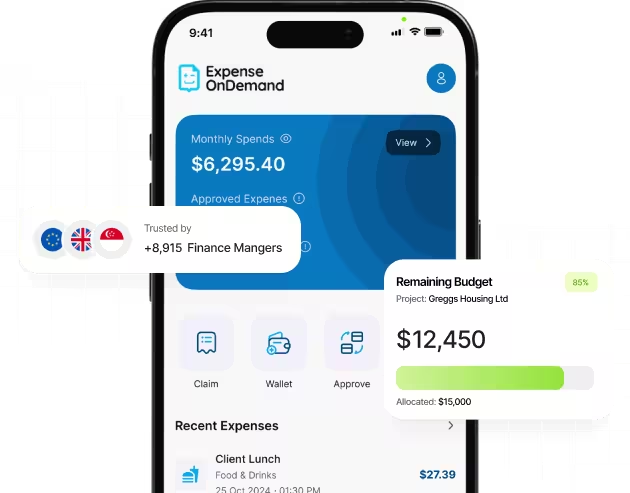
Bullet-proof clarity on budgets and spending is one simple but important way leaders can make sure they’re ready for the changing tides. ExpenseOnDemand is dedicated to making that a reality for business leaders and finance teams.
Davos 2026 made one thing clear: uncertainty is no longer episodic, it’s becoming part of the fabric of modern politics.
The organisations that thrive will not be those with the most rigid controls, but those with the clearest, fastest, and most trusted view of how money moves through their business.
At ExpenseOnDemand, this is exactly what we’re building, not as another tool, but as invisible financial infrastructure for modern organisations navigating an increasingly complex world.
If you’re concerned that you don’t have full visibility on budgets and spending, now is the time to reach out and talk to us!
%201.png)