
Remote work and hybrid office environments may have declined in the years following the pandemic, but they’re still very much a mainstay of many businesses.
As of 2025, up to 63% of all workers in the UK do some form of remote work as part of their job.
For expense management, this means businesses need a modern and adaptive solution that fits with this type of work. A flexible and accessible solution that offers all the features remote teams need to succeed.
In this blog, we’ll look at some of the key information businesses need to consider when thinking about onboarding expense management software for remote teams.
Modern remote workforces need flexibility and standardised practices, so it’s time to do away with Excel and bring your business into the 21st century. By moving to cloud-based expense management software, you can:
Excel was never designed to manage business expenses, yet many organisations have been set up to rely on it for their day-to-day spend management.
The problem is that spreadsheets introduce a long list of hidden inefficiencies: version mismatches, incorrect formulas, human errors, and lost attachments. As teams become more remote and business processes more complex, these issues scale quickly and become major roadblocks for finance departments.
Cloud-based expense management software eliminates these risks.
Employees can submit expenses from anywhere, managers approve on the go, and finance teams instantly access real-time data without juggling multiple versions of the same file.
Moving away from Excel isn’t just about convenience, it’s about building a reliable, scalable, and secure financial process that supports how businesses operate today.
Without clear, well-enforced expense policies, remote teams can easily fall into inconsistent spending habits and make claims that go against your budget restrictions or company spend allocation.
The solution is to create transparent, easy-to-understand policies that set expectations before expenses are incurred.
Modern expense management software makes this even more powerful by embedding those policies directly into the platform. If someone submits a claim that exceeds a category limit or breaks a rule, the system can flag it instantly.
This eliminates back-and-forth communication, reduces disputes, and ensures consistent compliance across the organisation. Clear policies not only protect budgets but also create a smoother, more predictable experience for everyone involved.
Managing expenses becomes dramatically easier when your expense software connects directly to your finance tools, ERP, payroll, and/or accounting system.
They ensure that expense data is always accurate, up-to-date, and aligned with budgets and reporting structures. This reduces reconciliation work, speeds up financial close cycles, and provides leadership with real-time insights into spend.
When you’re operating remotely (potentially across many timezones) and are not able to pop your head around the office door to check something in a report is accurate, having confidence that your system is designed to eliminate errors makes day-to-day financial management that bit less painful.
The success of any expense management rollout depends on employee adoption. Even the most intuitive platforms benefit from structured training.
This is especially important for remote teams, who don’t have easy access to in-person guidance, and are also less likely to be monitored by supervisors or management.
When employees understand how to capture receipts, submit claims, track mileage, and follow approval workflows, everything moves faster and with far fewer errors.
Good training doesn’t need to be complicated.
Onboarding sessions, quick-start guides, and a library of simple video walkthroughs are often enough to give teams confidence. It also helps to train managers and finance teams on how to review, approve, or reject claims efficiently.
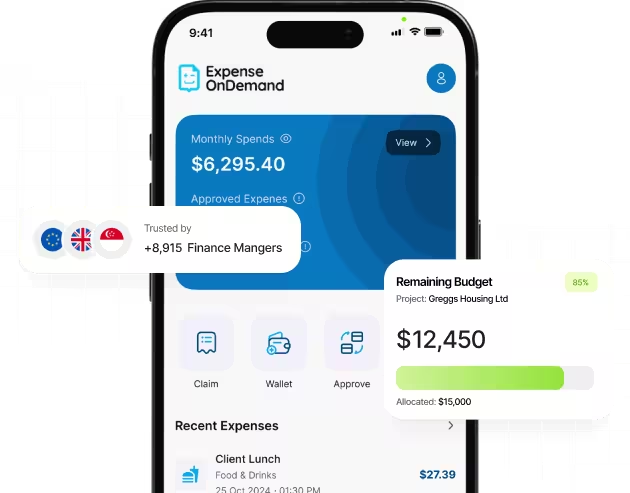
Mobile apps have completely transformed how employees submit expenses.
Instead of collecting paper receipts, waiting until the end of the week, and typing figures into a computer, users can snap a photo instantly using a receipt scanner app. OCR technology extracts all the key data, removing the need for manual entry and reducing the chance of mistakes.
For remote teams, this mobility is crucial.
Whether travelling, working from a client site, or simply grabbing a coffee between meetings, employees can log expenses in seconds.
Finance teams benefit too.
Real-time submissions mean fewer end-of-month bottlenecks and more accurate forecasting. In a world where people work from anywhere, a strong mobile expense experience isn’t optional, it’s foundational to modern expense management.
Mileage claims are historically one of the hardest areas to manage.
Manual logs rely on memory, estimates, or rough mapping, all of which introduce inaccuracies. For finance teams, this often results in overclaimed distances, inconsistent records, and long reconciliations.
GPS-enabled mileage tracking solves all of these issues with automation, which is absolutely perfect for remote and on-the-go teams.
A built-in mileage tracker allows employees to start and stop trips with one tap.
The system calculates the exact distance travelled and applies the company’s predefined mileage rate. This ensures accuracy, consistency, and compliance with internal policies and tax authority guidelines like HMRC or the IRS.
%201.png)