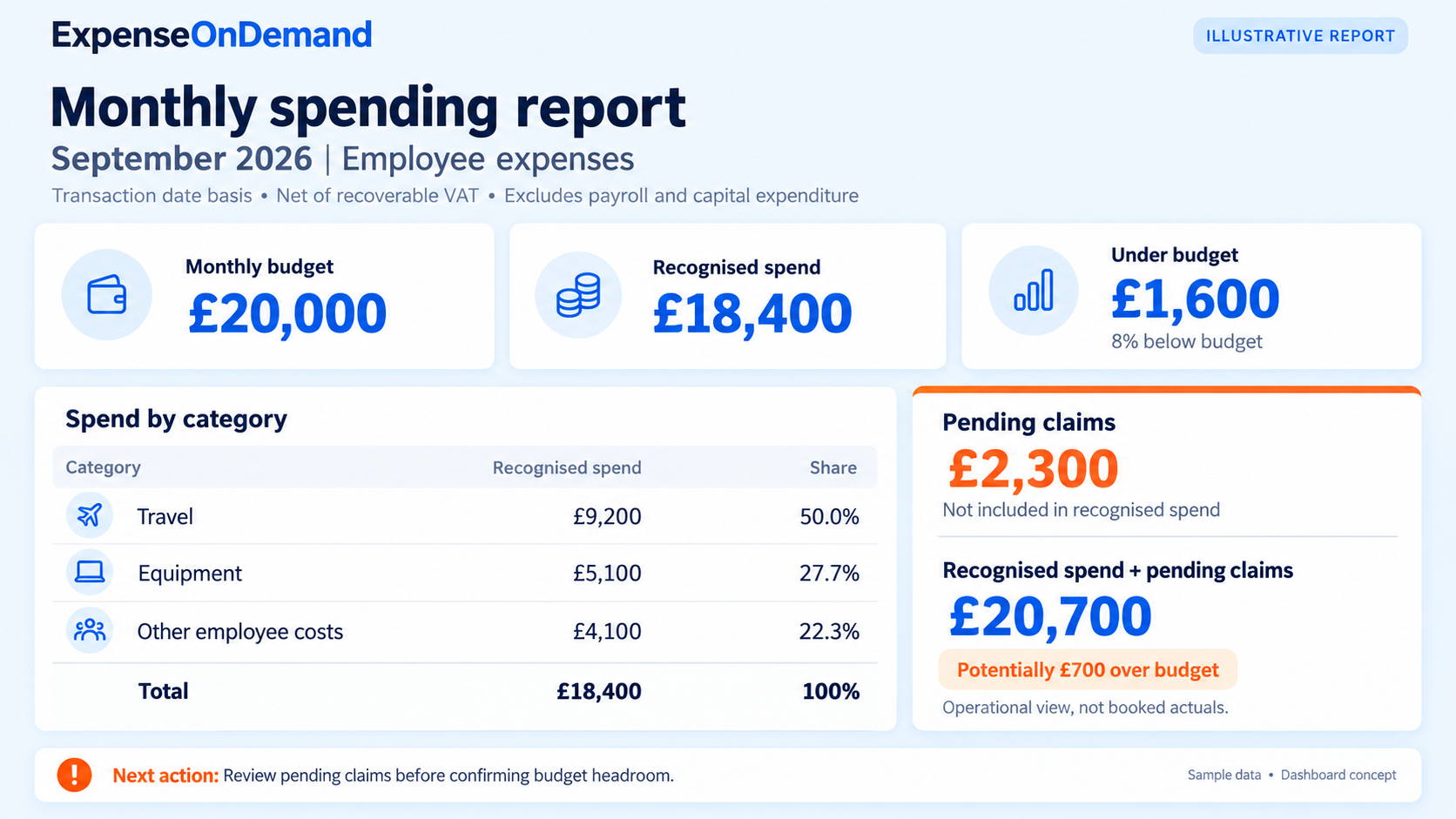
A monthly business spending report should show how much the business spent, where the money went, how it compares with budget and which items need attention. Include the reporting period, calculation basis and outstanding expenses. Finish with a small number of decisions or actions, each assigned to someone who can resolve it. A monthly spending report brings relevant costs together so managers can review patterns and decide what to do next. It should also state which spending is outside its scope.
Step one should always be:
Decide whether the report covers employee expenses only or also includes supplier invoices, subscriptions and other costs.
If payroll and capital expenditure are excluded, make sure this is clear.
A report labelled "total company spending" should not quietly contain only reimbursed receipts.
Next, set the reporting period and date basis.
Transaction date, accounting date and payment date can place the same purchase in different months. Choose the basis that answers the management question, then reconcile any difference from the ledger rather than expecting every total to match automatically.
The Financial Reporting Council encourages "clarity, conciseness and cohesiveness" in corporate reporting.
Its strategic report guidance addresses a different reporting context, but that communication principle is useful here:
Select information that helps the reader understand performance rather than adding every available field.
Show the period budget, reported spend and variance in pounds against the budget. Add the percentage variance if it makes comparison easier.
We recommend that you keep the direction obvious by writing "£2,000 over budget" rather than leaving readers to interpret whether a positive number is good or bad.
And use comparable figures.
A net-of-recoverable-VAT budget should not be compared with gross expenses without adjustment or explanation. If one-off expenditure is material, show it separately while keeping it inside your reconciled total.
Department, expense category and project are usually good starting points for categorizing your spend report.
Choose the views that match how managers make decisions.
Supplier detail can help investigate concentration or recurring charges, but a long list of tiny purchases rarely belongs on the first page.
For an illustrative employee spending report, let’s assume a £20,000 budget and £18,400 of recognised expenses.
Let’s say in this example, the company also has £2,300 of distinct pending claims that are not included in the recognised expense total.
Showing these separately reveals possible pressure beyond the apparent underspend.
Do not describe the combined £20,700 as actuals; it is an operational view of actuals plus potential additional cost.
Make sure to add a short explanation beside each material variance.
You should state whether the difference is timing, volume, price or an error awaiting correction.
The Charity Commission's financial controls guidance includes explaining the "reasons for any differences" between forecasts and the current financial position.
Yes, that guidance applies to charities, but the principle translates well to management reporting:
Ask the owner to confirm what happens next. A timing difference might reverse next month, while an ongoing price increase may require a revised forecast.
Do not change the approved budget simply to remove a variance. Keep the original plan and any formally approved revision distinguishable.
List the value of missing receipts, unapproved claims, uncoded transactions and unmatched card purchases.
Keep this separate from the main category breakdown so managers can tell the difference between spending behaviour and incomplete administration.
Where data is missing, describe the limitation specifically.
For example, say that one office's card feed is complete only up to the 28th of September. That is more informative than a general warning that the figures may be inaccurate.
Keep transaction references available beneath the summary. HMRC requires employers to retain expense and benefit records for three years after the relevant tax year ends.
Other requirements, including VAT rules, may require longer retention. Set the retention schedule for the underlying records separately from the frequency of the management report.
We suggest you limit the closing actions of your report to matters that actually need a decision.
Examples include:
Each action needs an owner and a date; otherwise it is likely to reappear in next month's commentary.
I can also be helpful to track whether earlier actions from previous reports were completed.
Why?
If a missing-receipt problem has persisted for three months, reporting the count again is unlikely to solve it.
A useful monthly pack can follow a consistent order: scope, headline figures, department and category detail, outstanding items, explanations and actions. Keep detailed transaction exports available for investigation rather than placing them in the main narrative.
Business spend management software helps bring the expense information behind these reports together.
In ExpenseOnDemand, build the reporting process around the questions your managers actually ask, with agreed categories and budget ownership. A short report that leads to a decision is more valuable than a large export that nobody has time to interpret.
%201.png)