
86% of CFOs believe their businesses are making financially strategic decisions without sufficient data to inform said choices. Given the sheer scale of this figure, it’s hard to quantify exactly how many businesses that would be.
Making financial decisions without the benefit of concrete data poses serious long-term risk for any business.
82% of businesses that fail do so because of cashflow problems.
Early last year (2025), the BBC reported on a record-breaking jump in the volume of insolvency registrations. A huge number of businesses were also known to be in serious financial stress at the time, according to the same article.
While it is true there are numerous reasons as to why a business could end up in financial difficulties, one major problem is lack of spend visibility. Without spend visibility, businesses can easily put a foot wrong and quite literally pay the price.
Spend visibility refers to how clearly and accurately a business can see where its money is being spent.
It’s not just about knowing total expenses, it’s about having a detailed, real-time understanding of who is spending, what it’s being spent on, when transactions occur, and how those costs align with budgets and company policies.
The higher the level of spend visibility, the easier it is for finance teams to track cash flow, monitor budgets, and maintain control over organisational spending.
In practice, strong spend visibility is achieved through a combination of structured data, automated tracking, and integrated systems.
Lack of spend visibility often shows up as fragmented, delayed, or completely hidden expenses across the business.
This includes employees paying out-of-pocket and submitting claims weeks later, corporate card transactions without receipts, or teams purchasing tools and subscriptions without finance oversight.
Travel and mileage are frequently logged after the fact, introducing inaccuracies and gaps in data. In all of these situations, spending only becomes visible after it has already happened, when it’s too late to guide or control it.
When businesses operate without real-time insight into spend, finance teams are forced into a reactive position. Budgets may look healthy on paper, but unexpected costs surface at the end of the month, disrupting planning and forecasting.
Reporting becomes unreliable, policies are inconsistently enforced, and small exceptions gradually become standard practice.
As an example, an employee purchases a £120 software subscription for their team:
In isolation, this isn’t really a problem. At scale, it can create massively inconsistencies, huge and unexpected holes in budgets, and wildly inaccurate financial projections.
Spend visibility has become critical as businesses face increasingly decentralised and fast-moving spending.
With employees purchasing software, travel, and services across multiple channels (often outside traditional procurement) finance teams can no longer rely on delayed reporting or manual processes to stay in control.
At the same time, economic pressure is forcing organisations to justify every cost and optimise cash flow in real time. Without clear, up-to-date visibility, businesses risk making decisions based on outdated or incomplete data. Modern expense management approaches solve this by providing instant insight into spend as it happens, enabling finance to shift from reactive oversight to proactive control.
Good spend visibility means finance teams have complete, real-time insight into company spending.
Rather than relying on delayed reports and manual approvals, businesses need to capture spend at the moment it happens, automatically applying policies and logging transactions instantly. This ensures that every expense is visible, categorised, and compliant from the outset, not reviewed after the fact.
In this model, control shifts from reactive to proactive.
Finance teams can see budget impact as it occurs, enforce policies automatically, and rely on accurate, up-to-date data for reporting and forecasting. At the same time, employees benefit from a seamless experience, with fewer forms, faster approvals, and less back-and-forth.
Ultimately, strong spend visibility creates a balance: employees move quickly, while finance retains continuous oversight and control. The result is better decision-making, reduced risk, and a clearer, more reliable picture of organisational spend.
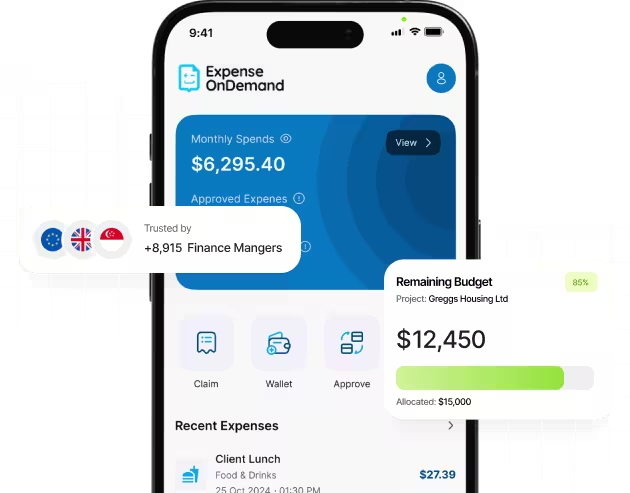
Spend management systems like ExpenseOnDemand are designed to eliminate the gaps and delays that reduce spend visibility. Delivering critical information that helps CFO and business leaders make strategic decisions based on genuinely accurate financial data.
Instead of relying on manual uploads, disconnected tools, or end-of-month reporting, spend management systems centralise all expense activity into a single, real-time platform.
Every transaction—whether it’s a receipt scan, mileage claim, or corporate card payment—is captured as it happens, automatically enriched with key data, and made instantly visible to finance teams.
By embedding policy controls and automated workflows into the process, these systems ensure that spend is not only visible but also accurate and compliant from the outset. Expenses are categorised, checked against company rules, and routed through customised approval workflows without manual intervention. This removes the need for retrospective reviews and significantly reduces errors, missing information, and policy breaches.
Crucially, with features like real-time transaction feeds, mileage tracking, and ERP integrations, ExpenseOnDemand creates a continuous flow of clean, connected data.
Finance teams gain a live view of budgets, cash flow, and spend patterns across the organisation.
Our five pillars of Frictionless Finance, built into our spend management systems, work together to strengthen and sustain high-quality spend visibility across the organisation.
- Pillar 1: By capturing spend intent at the source, businesses gain immediate insight into upcoming and in-progress costs, not just completed transactions.
- Pillar 2: Preventive controls ensure every expense is validated against policy and budgets in real time, so visibility is not only instant but also reliable and compliant from the outset.
- Pillars 3 & 4: Continuous reconciliation and integrated systems then ensure that all spend data remains accurate, connected, and up to date across finance, ERP, and operational workflows. This removes reporting delays and eliminates fragmented data sources.
- Pillar 5: Finally, cross-functional visibility brings all spend, whether expenses, mileage, travel, or ESG-related costs, into a single, unified view.
Together, these pillars transform spend visibility from a lagging, partial snapshot into a complete, real-time picture of organisational spend, enabling faster decisions, stronger control, and greater financial confidence.
Strong spend visibility is only valuable if you actively use it.
Start by segmenting your spend data (if you use a system like ExpenseOnDemand, this is done for you) break it down by department, category, project, or supplier. This quickly highlights where money is actually going and makes it easier to spot patterns, such as rising costs, duplicate tools, or teams consistently exceeding budgets.
Next, compare real-time spend against your budgets and policies.
Don’t wait for month-end reports, use live data to identify issues early. If a department is trending over budget or certain expense types are increasing, you can step in immediately by adjusting limits, reinforcing policies, or reallocating resources before the problem grows.
Finally, use these insights to take action.
Consolidate suppliers where possible, eliminate unnecessary spend, and double down on areas that deliver value. Over time, this creates a continuous improvement loop: visibility leads to insight, insight drives action, and action improves how your business spends.
When strong spend visibility is in place, the impact is both immediate and measurable across finance operations:
The result is a finance function that is not only more efficient, but more strategic, using live spend data to guide decisions, control costs, and support sustainable growth.
As a business, ExpenseOnDemand has been operational for over two decades. In that time we’ve developed a deep understanding of what businesses need to succeed when it comes to finance management.
While we started with humble roots in pure expense management, our platform has evolved to be far more dynamic, covering expenses, AP & procurement, financial reporting, account integration, travel management, globalised multi-currency systems, ESG and more.
This complete coverage of end-to-end business spend modeling means that we can now offer a single platform for all elements of spend management. For true spend visibility, our system provides all your business could ever need.
Take a free trial or sign up for a demo today to find out for yourself.
%201.png)